A cross-lingual analysis of mathematics, physics and chemistry textbook knowledge — across China, Germany, the United Kingdom and the United States — measured through structural graph metrics and curriculum alignment.
Same 173s cut — switching keeps your position.
Three complementary lenses on how the same knowledge is organized differently
How do different languages organize the same knowledge?
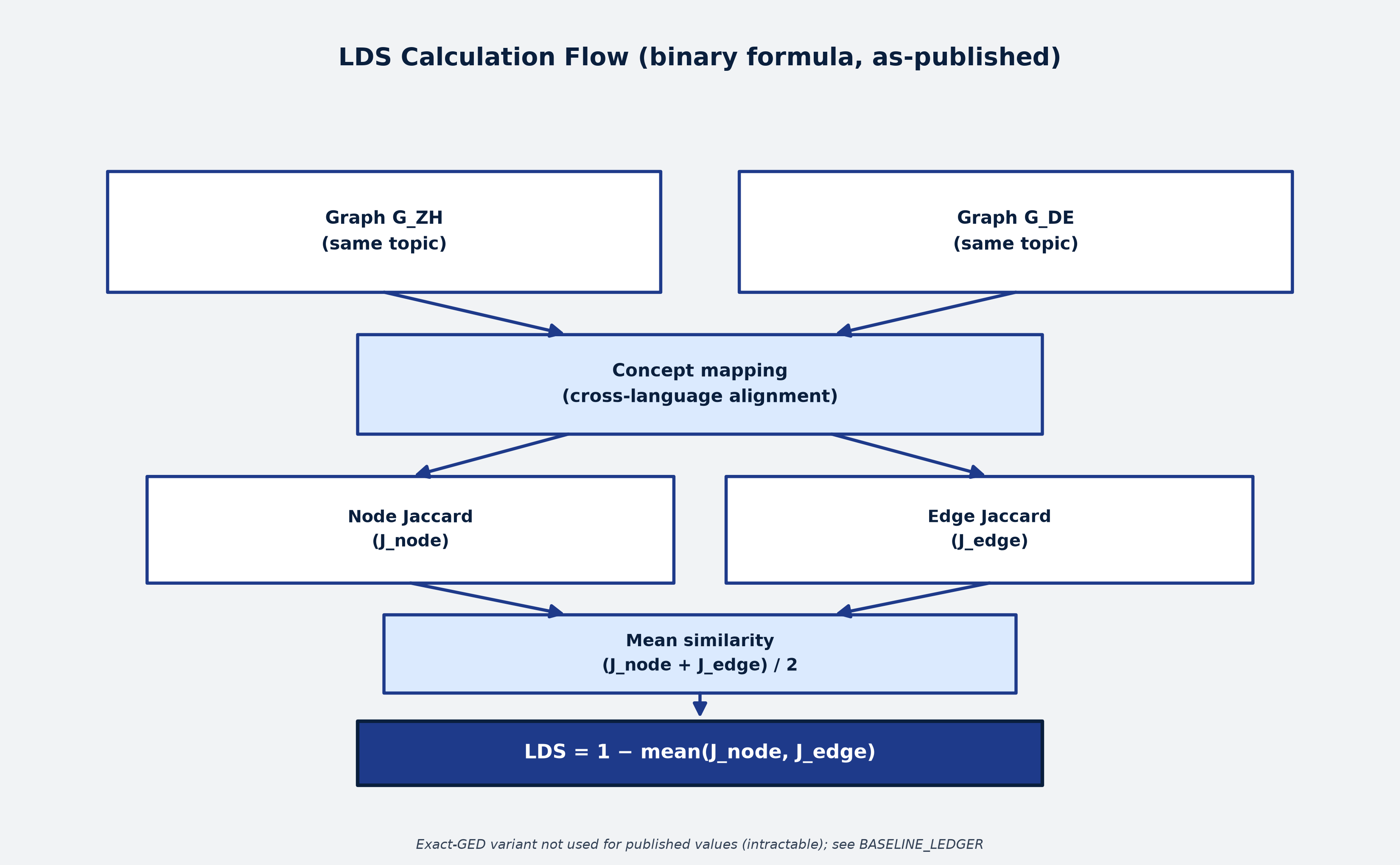
LDS-K reveals heterogeneous cross-linguistic relationships: ZH-DE (0.519) textbooks converge substantially; ZH-EN (0.934) and DE-EN (0.938) are near the within-language noise floor. A Null Model falsifies the language-divergence interpretation — the core signal is ΔLDS (cognitive minus textbook).
How do different STEM subjects organize knowledge?
All three disciplines follow an early-peak-later-decline pattern. Knowledge density peaks at middle or elementary school, then drops sharply. Maximum prerequisite depth is bounded at 8.
How do different curricula organize the same subject?
Coverage scores range from 12.7% (NRW) to 95.4% (China). Granularity (safest reading) and governance (hypothesis, paper §8.6) both fit these differences.
What this project delivers to the field
1,140+ concepts and 1,100+ direct relations across mathematics, physics and chemistry in Chinese, English and German — extracted from 180 textbooks and validated against 92 gold-standard annotations (social F1 = 0.939; weighted overall 0.881).
CDS (concept density), HDS (hierarchy depth) and LDS (language drift) quantify how knowledge is connected, sequenced and structured across languages and disciplines.
The Coverage Score measures textbook–curriculum alignment across four education systems (Germany, UK, US, China), revealing how different educational philosophies produce systematically different alignment patterns.
12 findings spanning density universals (F1–F3, F6–F8), cross-language divergence (F4–F5), curriculum design philosophy (F9–F10), and human-validation revision (F11–F12) — all independently verifiable from the released data and pipeline.
From textbook text to structural insights in five steps
Every textbook cited by at least one graph concept. Node cards show the top-3 sources per concept; this is the full inventory (204 titles).
Local texts (2026-09-12): 89 open files + CN 11 books OCR done, fact-level (51 chapter txts). Text-grounded: physics ZH 66.5% / EN 62.1%, chemistry ZH 65.9% / EN 53.2% (semantic layer; substring 33.8/25.5) (college nodes out of high-school scope; DE link-only).
| Title | Lang | Refs |
|---|---|---|
| A First Course in Probability (Sheldon Ross) | en | 24 |
| AP Calculus AB/BC | en | 34 |
| Abitur Mathematik Leistungskurs (Baden-Württemberg) | de | 28 |
| Cambridge IGCSE Mathematics (0580) | en | 21 |
| Differential Equations and Linear Algebra (Edwards & Penney) | en | 14 |
| Erwin Fischer: Lineare Algebra | de | 10 |
| Gewöhnliche und partielle Differentialgleichungen | de | 14 |
| Gilbert Strang: Introduction to Linear Algebra (18.06) | en | 28 |
| IB Mathematics: Analysis and Approaches SL/HL | en | 18 |
| Khan Academy Mathematics 3-4 | en | 10 |
| Khan Academy Mathematics 3rd-5th Grade | en | 21 |
| Khan Academy Mathematics 5-6 | en | 15 |
| Khan Academy Mathematics 6th-8th Grade | en | 37 |
| Khan Academy Mathematics K-2 | en | 13 |
| Lambacher Schweizer 5-8 Klasse | de | 17 |
| Lambacher Schweizer Mathematik (erweitert) | de | 30 |
| Otto Forster: Analysis 1 | de | 21 |
| Otto Forster: Analysis 2 | de | 7 |
| Stewart Calculus (8th ed.) | en | 31 |
| Wahrscheinlichkeitsrechnung und Statistik | de | 24 |
| Westermann Mathematik Klasse 9-10 | de | 26 |
| 人教版《偏微分方程基础》 | zh | 8 |
| 人教版初中数学七年级 | zh | 15 |
| 人教版初中数学九年级 | zh | 18 |
| 人教版初中数学八年级 | zh | 17 |
| 人教版小学数学一年级上册 | zh | 10 |
| 人教版小学数学一年级下册 | zh | 11 |
| 人教版小学数学二年级上册 | zh | 9 |
| 人教版小学数学二年级下册 | zh | 9 |
| 人教版高中数学选修2-2 | zh | 85 |
| 同济大学《线性代数》 | zh | 64 |
| 浙江大学《概率论与数理统计》 | zh | 64 |
| Title | Lang | Refs |
|---|---|---|
| A-Level Physics (AQA) | en | 136 |
| A-Level Physics (OCR) | en | 136 |
| AP Physics 1 | en | 136 |
| AP Physics 2 | en | 136 |
| AP Physics C: E&M | en | 136 |
| AP Physics C: Mechanics | en | 136 |
| Arfken: Mathematical Methods | de | 127 |
| Auer: Physik | de | 93 |
| BBC Bitesize: KS3 Physics | en | 93 |
| Cambridge IGCSE Physics | en | 136 |
| CK-12: Elementary Physical Science | en | 10 |
| CK-12: Middle School Physics | en | 93 |
| Cornelsen: Physik aktiv | de | 93 |
| Cornelsen: Physik entdecken | de | 10 |
| Cornelsen: Physik Oberstufe | de | 136 |
| Demtröder: Experimentalphysik | de | 381 |
| Dorn-Bader: Physik | de | 136 |
| DUDEN: Physik Abitur | de | 136 |
| Duden: Physik Kompakt | de | 103 |
| Feynman Lectures on Physics | en | 254 |
| GCSE AQA Physics | en | 136 |
| GCSE Edexcel Physics | en | 136 |
| Glencoe: Physics: Principles and Problems | en | 93 |
| Greiner: Klassische Mechanik | de | 127 |
| Greiner: Quantenmechanik | de | 127 |
| Greiner: Thermodynamik und Statistische Mechanik | de | 127 |
| Griffiths: Introduction to Electrodynamics | en | 127 |
| Halliday Resnick Walker: Fundamentals of Physics | en | 254 |
| Holt: Middle School Science | en | 93 |
| IB Physics SL/HL | en | 136 |
| IGCSE Physics (0625) | en | 136 |
| Jackson: Klassische Elektrodynamik | de | 127 |
| Kern: Physik | de | 136 |
| Khan Academy Physics | en | 93 |
| Khan Academy: Elementary Science | en | 20 |
| Kittel: Introduction to Solid State Physics | en | 127 |
| Kleintolkroemer: Classical Electrodynamics | en | 127 |
| Klett: Physik | de | 93 |
| Lambacher Schwere: Physik | de | 186 |
| Landau Lifshitz: Mechanics | en | 127 |
| LEIFIphysik Induktion | de | 1 |
| National Geographic: Force, Motion, and Simple Machines | en | 10 |
| NPTEL Sensor Technologies | en | 1 |
| Pearson: Prentice Hall Science Explorer | en | 93 |
| Schiff: Quantenmechanik | de | 127 |
| Schrödinger: Quantum Mechanics | en | 127 |
| Serway Jewett: Physics for Scientists and Engineers | en | 254 |
| Thieme: Physik | de | 136 |
| Tipler: Physik | de | 254 |
| Westermann: Physik | de | 103 |
| Westermann: Physik Oberstufe | de | 136 |
| Young Freedman: University Physics | en | 254 |
| 人教版初中物理九年级全一册 | zh | 93 |
| 人教版初中物理八年级上 | zh | 93 |
| 人教版初中物理八年级下 | zh | 93 |
| 人教版小学科学三年级上 | zh | 10 |
| 人教版小学科学五年级上 | zh | 10 |
| 人教版小学科学四年级上 | zh | 10 |
| 人教版高中物理必修第一册 | zh | 136 |
| 人教版高中物理必修第三册 | zh | 136 |
| 人教版高中物理必修第二册 | zh | 136 |
| 人教版高中物理选择性必修第一册 | zh | 136 |
| 人教版高中物理选择性必修第三册 | zh | 136 |
| 人教版高中物理选择性必修第二册 | zh | 136 |
| 光学(赵凯华) | zh | 127 |
| 力学(漆安慎) | zh | 127 |
| 北师大版初中物理八年级 | zh | 93 |
| 北师大版小学科学四年级 | zh | 10 |
| 原子物理学(杨福家) | zh | 127 |
| 大学物理(马文蔚) | zh | 254 |
| 普通物理学(程守洙) | zh | 254 |
| 沪教版小学科学三年级 | zh | 10 |
| 沪科版初中物理八年级 | zh | 93 |
| 沪科版高中物理 | zh | 136 |
| 热学(汪志诚) | zh | 127 |
| 理论力学(梁昆淼) | zh | 127 |
| 电动力学(郭硕鸿) | zh | 127 |
| 电磁学(赵凯华) | zh | 127 |
| 粤教版初中物理八年级 | zh | 93 |
| 粤教版高中物理 | zh | 136 |
| 苏科版初中物理八年级 | zh | 93 |
| 量子力学(曾谨言) | zh | 127 |
| 鲁科版高中物理 | zh | 136 |
| Title | Lang | Refs |
|---|---|---|
| A-Level Chemistry (AQA) | en | 51 |
| A-Level Chemistry (OCR) | en | 51 |
| AP Chemistry | en | 51 |
| Atkins: Physical Chemistry | en | 123 |
| Atkins: Physikalische Chemie | de | 123 |
| Auer Chemie | de | 46 |
| BBC Bitesize KS3 Chemistry | en | 46 |
| Brown: Chemistry | en | 123 |
| Bruice: Organic Chemistry | en | 123 |
| Bruice: Organische Chemie | de | 123 |
| Cambridge IGCSE Chemistry | en | 51 |
| Chang: Chemistry | en | 123 |
| CK-12 Chemistry | en | 46 |
| Clayden: Organic Chemistry | en | 123 |
| Clayden: Organische Chemie | de | 123 |
| Cornelsen Chemie entdecken | de | 46 |
| Cornelsen Chemie Oberstufe | de | 51 |
| Dorn-Bader Chemie | de | 46 |
| Dorn-Bader Chemie Abitur | de | 51 |
| DUDEN Chemie Abitur | de | 51 |
| Duden Chemie Kompakt | de | 46 |
| Edexcel GCSE Chemistry | en | 51 |
| Engel: Physical Chemistry | en | 123 |
| Engel: Physikalische Chemie | de | 123 |
| GCSE AQA Chemistry | en | 51 |
| GCSE AQA Combined Science | en | 51 |
| GCSE Edexcel Chemistry | en | 51 |
| Glencoe Chemistry | en | 46 |
| Harris: Quantitative Chemical Analysis | en | 123 |
| Harris: Quantitative Chemische Analyse | de | 123 |
| Holt Chemistry | en | 46 |
| Housecroft: Anorganische Chemie | de | 123 |
| Housecroft: Inorganic Chemistry | en | 123 |
| IB Chemistry SL/HL | en | 51 |
| IGCSE Chemistry (0620) | en | 51 |
| Kern Chemie Abitur LK | de | 51 |
| Khan Academy Chemistry | en | 46 |
| Klett Chemie | de | 46 |
| Laidler: Physikalische Chemie | de | 123 |
| Levine: Physical Chemistry | en | 123 |
| Levine: Physikalische Chemie | de | 123 |
| Mortimer: Physikalische Chemie | de | 123 |
| Pearson: Prentice Hall Chemistry | en | 46 |
| Petrucci: General Chemistry | en | 123 |
| Shriver & Atkins: Anorganische Chemie | de | 123 |
| Shriver & Atkins: Inorganic Chemistry | en | 123 |
| Silberberg: Chemie | de | 123 |
| Silberberg: Chemistry | en | 123 |
| Skoog: Analytical Chemistry | en | 123 |
| Skoog: Analytische Chemie | de | 123 |
| Solomons: Organic Chemistry | en | 123 |
| Thieme Chemie | de | 51 |
| Wade: Organic Chemistry | en | 123 |
| Westermann Chemie | de | 46 |
| Westermann Chemie Oberstufe | de | 51 |
| Zumdahl: Chemistry | en | 123 |
| 人教版初中化学九年级上 | zh | 46 |
| 人教版初中化学九年级下 | zh | 46 |
| 人教版高中化学必修第一册 | zh | 51 |
| 人教版高中化学必修第二册 | zh | 51 |
| 人教版高中化学选择性必修第一册(化学反应原理) | zh | 51 |
| 人教版高中化学选择性必修第三册(有机化学基础) | zh | 51 |
| 人教版高中化学选择性必修第二册(物质结构与性质) | zh | 51 |
| 分析化学(华东理工) | zh | 123 |
| 分析化学(武汉大学) | zh | 123 |
| 化工原理(柴诚敬) | zh | 123 |
| 北师大版初中化学 | zh | 46 |
| 无机化学(大连理工) | zh | 123 |
| 无机化学(武汉大学) | zh | 123 |
| 有机化学(汪小兰) | zh | 123 |
| 有机化学(邢其毅) | zh | 123 |
| 材料化学(曾兆华) | zh | 123 |
| 沪教版初中化学 | zh | 46 |
| 沪科版高中化学 | zh | 51 |
| 湘教版初中化学 | zh | 46 |
| 湘教版高中化学 | zh | 51 |
| 物理化学(傅献彩) | zh | 123 |
| 物理化学(南京大学) | zh | 123 |
| 环境化学(戴树桂) | zh | 123 |
| 生物化学(王镜岩) | zh | 123 |
| 科粤版初中化学 | zh | 46 |
| 粤教版初中化学 | zh | 46 |
| 粤教版高中化学 | zh | 51 |
| 结构化学(周公度) | zh | 123 |
| 苏教版初中化学 | zh | 46 |
| 苏教版高中化学 | zh | 51 |
| 高分子化学(潘祖仁) | zh | 123 |
| 鲁教版初中化学 | zh | 46 |
| 鲁科版高中化学 | zh | 51 |
Refs = citations across concepts. New textbooks are appended here on ingestion (see docs/physics_sourcing.md for the gap list). Raw excerpts live in data/textbook/.
Five finding sections covering twelve numbered results (F1–F12): how knowledge is organized across disciplines, languages, education systems, and individuals
Mathematics peaks at middle school (CDS = 0.271). Physics peaks at elementary school (CDS = 0.222). Chemistry shares the same middle school peak (CDS = 0.042). After the peak, density drops sharply — a 3.7× decline from middle to high school in mathematics.
This contradicts the natural assumption that "more advanced knowledge is more densely connected." Instead, curricula are designed to maximize connection density during foundational stages (early integration) before branching into specialization (later differentiation).
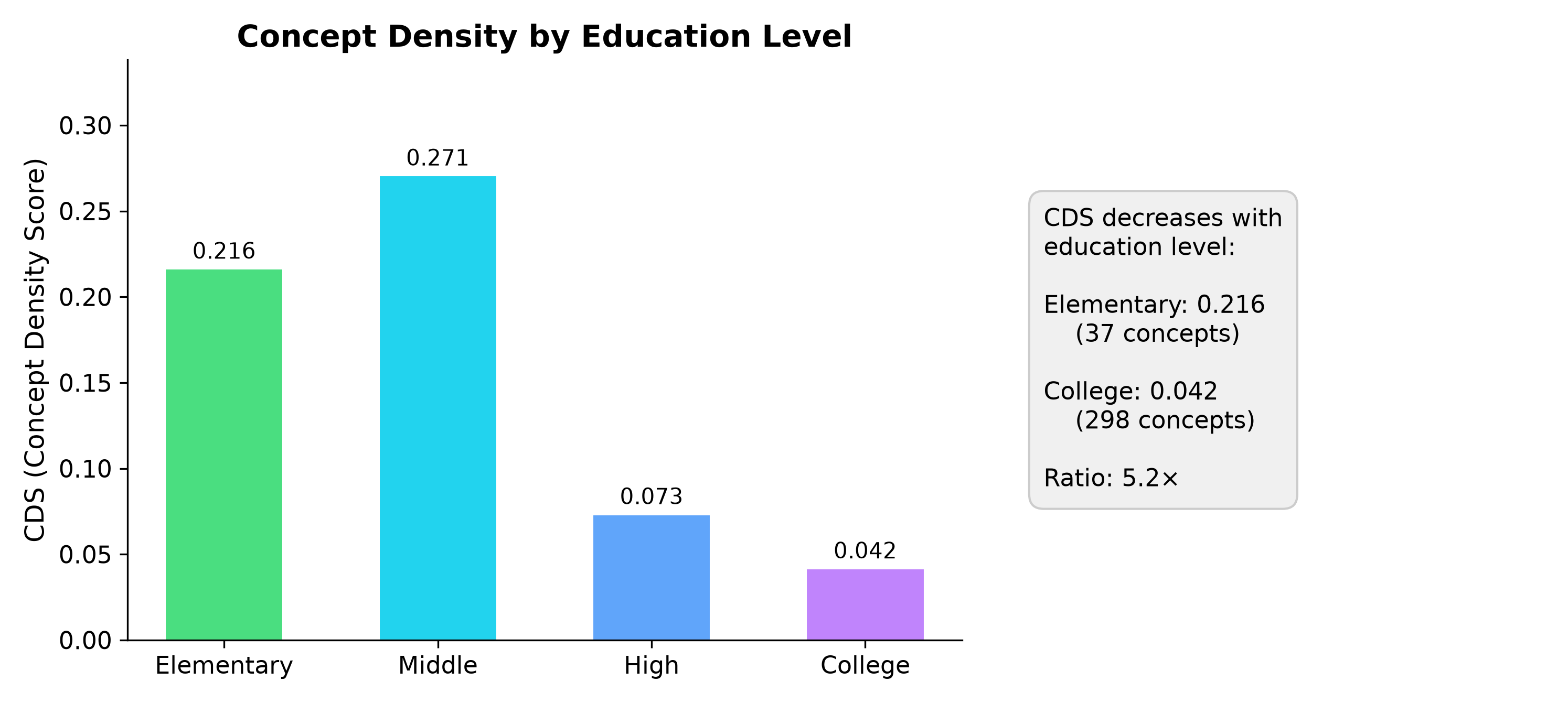
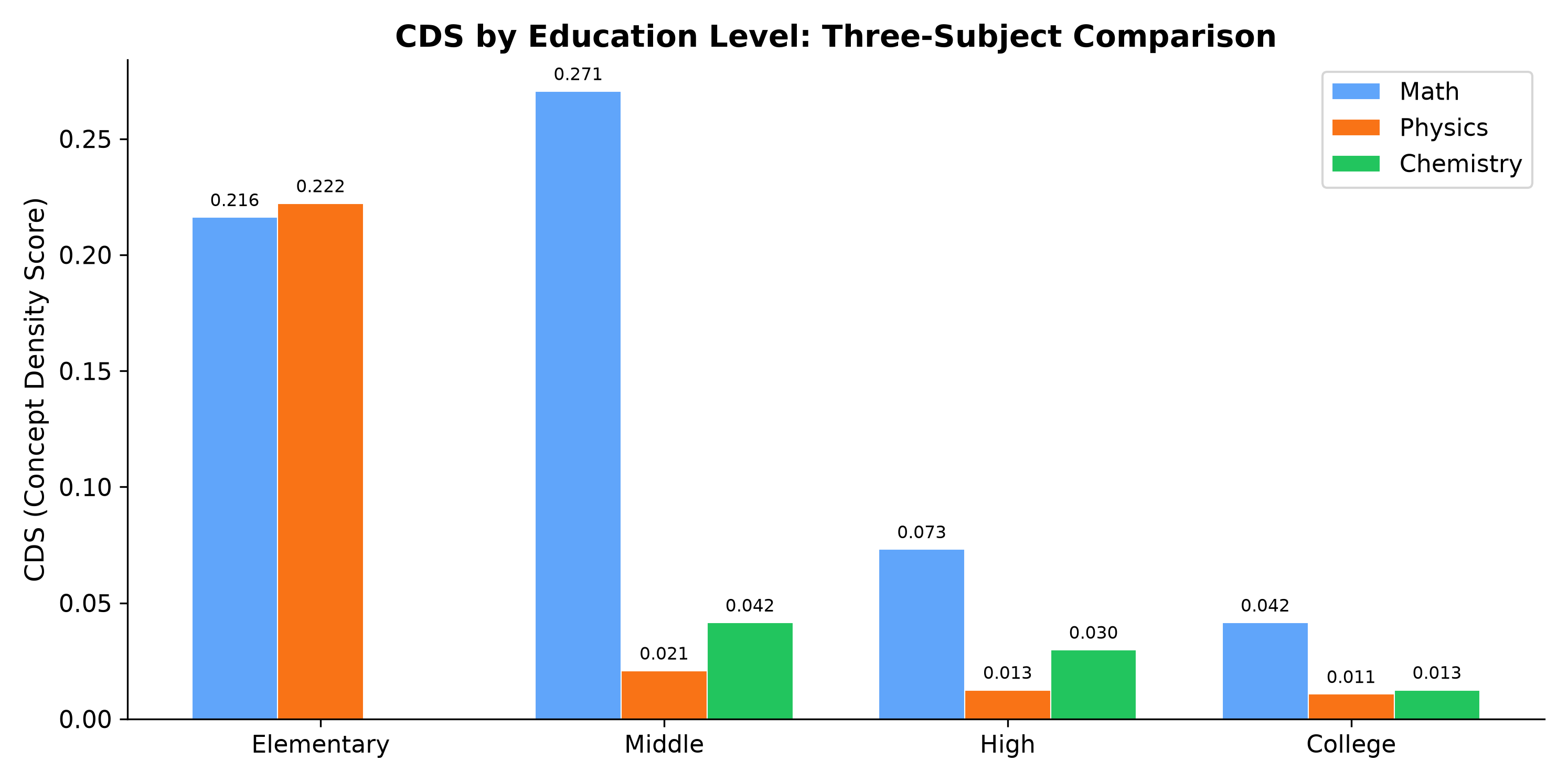
Source. CDS per level from the math graph (Fig 3) and the three-discipline matrix (outputs/physics_comparison.json + chemistry_comparison.json, Fig 7) — the same numbers as the CDS Terrain view.
Method. CDS = 2|E|/(|V|·(|V|−1)) per level cell; the math graph renders 238 of 525 relations. Nothing is rescaled.
Reading. Height = density; an early peak then decline in all three subjects (math middle 0.271, physics elementary 0.222, chemistry middle 0.042).
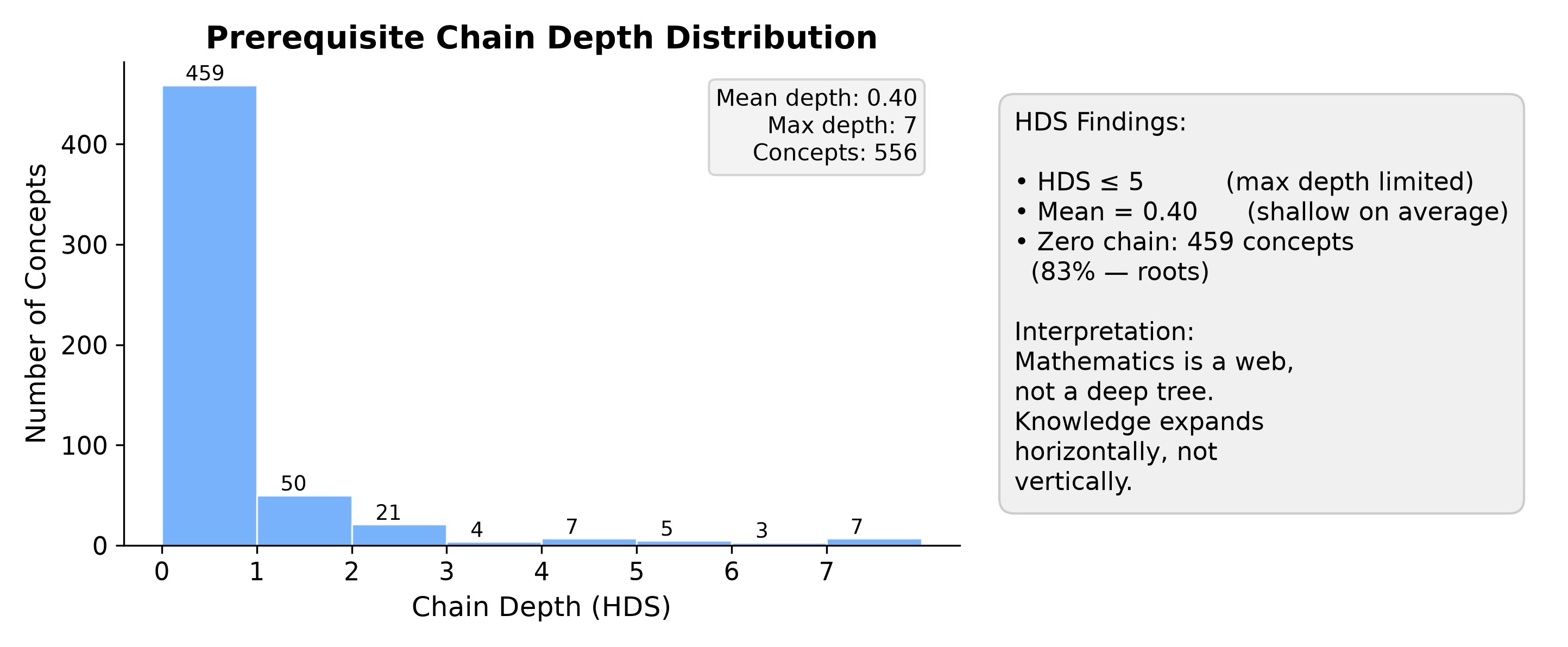
Maximum prerequisite chain depth is HDS ≤ 8 for mathematics and HDS ≤ 6 for physics. Mean depth is even lower: 0.40 for math, 0.85 for physics. Over 83% of math concepts have no prerequisite chains at all (root concepts).
Physics has 2.1× more sequential depth than mathematics (60% roots in physics vs 83% in math), reflecting its more cumulative knowledge structure. But both disciplines respect the same shallow upper bound — suggesting a pedagogical or cognitive constraint on how knowledge can be sequenced.
Textbook structures look more convergent than random expectation — but decontamination falsifies this reading. ZH-DE (LDS-K = 0.519) collapses to 0.990 once de-labels containing Chinese text (167/219) are removed: the apparent convergence is a label artifact, not content convergence. ZH-EN (0.934) and DE-EN (0.938) sit near the within-language noise floor (0.97, textbook line) either way.
The pattern is also topic-dependent: within each language pair, LDS varies by up to 0.2 across the 5 social topics analyzed, suggesting that some knowledge domains are more culturally inflected than others.
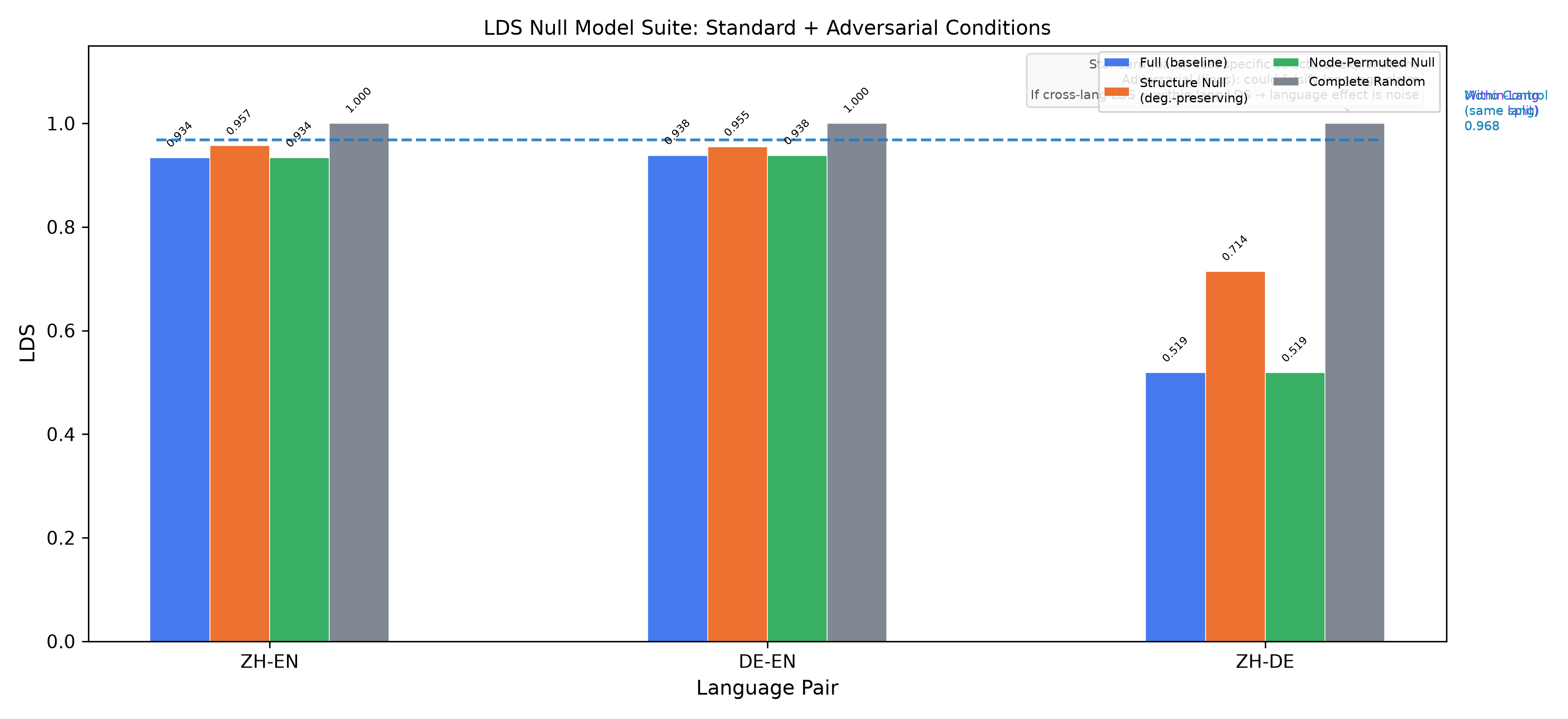
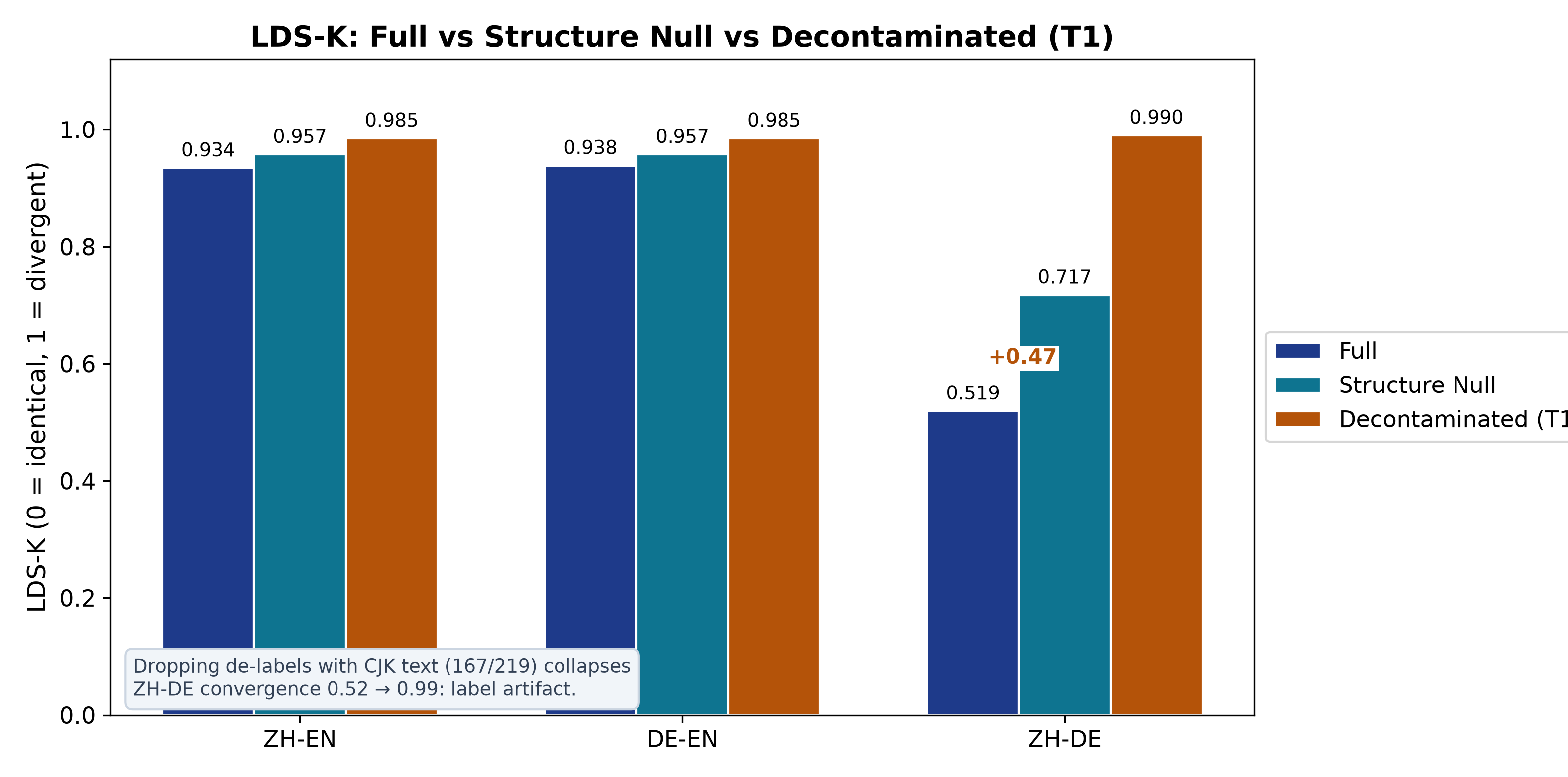
Honesty note (T1 decontamination, 2026-09): ZH-DE J_node 0.556 → 0.020 after removing CJK-contaminated de-labels; size-matched bootstrap reverses the wiki comparison at every k. Verdict: label artifact (paper §3.8, Fig 8).
Coverage scores range from 12.7% (NRW) to 95.4% (China). China shows near-perfect alignment under a centralized national curriculum. The UK (37.3%) shows moderate alignment through its national curriculum. The US (17.2%) and NRW (12.7%) reflect broad or detailed standards that afford local adaptation. These differences are consistent with educational governance (hypothesis, paper §8.6) — but granularity (A) remains the safest interpretation; the data fit all three explanations below.
Fig 8 — Overall Coverage Score (paper §8.5: NRW 12.7% · UK 37.3% · US 17.2% · China 95.4%)
Source. Overall column of config/expert_graphs/coverage_all_curricula.json (paper §8.5) — the same table behind the coverage cards and Coverage Towers.
Method. Keyword bridge + 2-overlap threshold; overall = matched/total across all stages per system.
Reading. Bar = system overall; the gap runs China 95.4% down to NRW 12.7%.
F9 Coverage scores vary dramatically across education systems (12.7%–95.4%). Granularity (safest reading) and governance (hypothesis, paper §8.6) both fit these differences.
F10 China's near-perfect alignment (95.4%) versus NRW's low alignment (12.7%) reflects the spectrum from centralized curriculum to local adaptation.
Extended study (6 DE · 6 ZH · 3 EN): concept-level LDS-C (human) is 0.93–0.96 — indistinguishable from the within-language split-half floor (0.92–0.96) and label permutation (0.94). Concept-level ΔLDS ≈ 0 (−0.05…+0.05); relation-level Δ is not comparable across sparsity regimes. Pilot N=8 values (0.70–0.75) were not replicated and are reported for transparency only. The earlier human-vs-simulation comparison (p=0.05) is withdrawn (measurement-scale drift).
| Level | DE–ZH | DE–EN | ZH–EN | Rank Order |
|---|---|---|---|---|
| Human N=15 (Between) | 0.93–0.96 | 0.93–0.96 | 0.93–0.96 | ≈ floor |
| LLM Within-Subject | ≫ floor (+0.08–0.09) | ≫ floor | ≫ floor | signal |
| Textbook LDS-K | 0.519 | 0.938 | 0.934 | ✓ |
| Simulation Baseline | 0.646 | 0.655 | 0.640 | withdrawn* |
F11 N=15 falsifies ΔLDS > 0 between-subject: human LDS-C ≈ split-half floor — between-subject designs cannot separate language from participant variance.
F12 Concept-level ΔLDS ≈ 0; LLM within-subject margin (+0.08–0.09) shows the signal exists — earlier simulation comparison withdrawn.
Explore the mathematics subgraph in an interactive 3D knowledge graph — 556 nodes · 525 relations · 219 groups
Switch between zoom, rotate and fly modes. Explore the graph in three languages or switch discipline. Compare how different education systems structure the same mathematical knowledge.
Transparent assessment of methodological boundaries and potential biases
The corpus is not a comprehensive sample of all textbooks in each language. Chinese textbooks are predominantly one series (Renjiao), which may not represent the full diversity of Chinese mathematics education. German textbooks are weighted toward senior-level university texts (Forster, Fischer) with fewer primary-level resources.
Only three STEM disciplines (mathematics, physics, chemistry) were analyzed. The framework has not been validated on humanities, social sciences, or professional fields. The universal claims (e.g., "knowledge density peaks early") are therefore limited to STEM education.
Curriculum documents vary enormously in granularity: the US math curriculum contains 2,124 concepts while the UK science curriculum has 397 (paper §8: NRW 299 · UK 397 · US 2,124 · CN 87). Higher granularity mechanically lowers coverage scores when matched against the same textbook graph. This is partially mitigated by normalizing per-curriculum, but cross-system comparisons remain approximate.
Concept extraction depends on a single production model. The 19-model benchmark (F1 range 0.55–0.67) confirms extraction consistency across architectures. While F1 = 0.939 on social concepts, the math domain achieves only 0.674 overall (German as low as 0.506). Extraction errors propagate through all downstream metrics. Relation extraction (prerequisite links) is less reliable than concept identification.
Only three languages (ZH, EN, DE) were analyzed. These represent only two language families (Sino-Tibetan, Germanic) and one educational tradition cluster (Western Europe + East Asia). The framework's applicability to Romance, Slavic, Arabic, or other language families remains untested.
92 gold labels, while sufficient for overall F1 estimation (especially for social concepts, n=72), are limited for fine-grained per-language, per-domain analysis. The mathematical domain has only 20 labels across 3 languages, and the German math F1 estimate (0.506) has high variance.
How four education systems align their curricula with textbook content
Coverage decreases toward upper-secondary specialization. Teachers exercise curricular freedom — they select from the curriculum rather than covering all of it. Reflects a specialization-driven philosophy.
The exam-driven system drives comprehensive textbook coverage — every curriculum point must be taught because it might be tested. Moderate overall alignment (37.3%, paper §8.5).
Low overall coverage with stable trajectory across stages. The US standards define broad learning goals rather than detailed syllabi, giving textbook authors interpretive freedom while maintaining curriculum alignment.
Near-perfect alignment with a centralized national curriculum. Chinese textbooks closely follow the national syllabus, resulting in the highest coverage across all four systems. The highly selective, curriculum-driven textbook market aligns textbooks tightly with government standards.
Source. Per-stage rows of config/expert_graphs/coverage_all_curricula.json — the same table behind Coverage Towers.
Method. Keyword bridge + 2-overlap threshold (≥2 shared keywords = covered); card headline = system overall.
Reading. Each card narrates one system; the numbers match the bright overall bars in Coverage Towers.
Claims: Dense curricula produce higher coverage. Evidence: Counter-indicated — the US has the densest curriculum (2,124 concepts) but one of the lowest coverages (17.2%).
Coverage patterns reflect educational governance: CN centralized (95.4%), UK national curriculum (37.3%), US broad standards (17.2%), NRW per-track specifications (12.7%).
Some concepts may be taught in other subjects (e.g., physics in chemistry). Plausible but unverified — cross-subject concept mapping could reveal systematic transfers.
Gold standard annotations and model benchmarks
Human-annotated gold standard covering social concepts and mathematical concepts across all three languages. Validated against production-model extraction.
| Domain | ZH F1 | DE F1 | EN F1 | Overall | n |
|---|---|---|---|---|---|
| Social Concepts | 0.974 | 0.949 | 0.882 | 0.939 | 72 |
| Mathematics | 0.857 | 0.506 | 0.711 | 0.674 | 20 |
| All (weighted) | 0.951 | 0.842 | 0.844 | 0.881 | 92 |
Note: The low German math F1 (0.506) is a domain mismatch — the math gold labels use Chinese/English mathematical terminology not present in the German textbook corpus. Social concept extraction is uniformly strong across all three languages.
All free-quota Bailian API models tested on 92 gold labels. The production extraction model was selected by overall F1.
Source. 19 models scored on 92 gold labels (model-selection benchmark, Validation section).
Method. F1 on gold labels; the production extraction model was selected by overall F1. Range 0.55–0.67.
Reading. Bar = F1 per model. Used only for extractor selection — never for language claims (that is the 55-run replication below).
Fused view — all 55 full-run ZH-DE margins (LDS-C minus split-half floor) under one P1 protocol (ZH/DE/EN × 10); all 55 ZH-DE p<0.01; 8 EN n.s. among 165 (500 permutations). Western runs in red. The 31 collecting runs (incl. qwen-max n=29/30, per paper §8.15) withhold margins until n=30. Source: data/lds_c/llm_subject/multi_model_replication_20260910.json + paper §5.10.
Source. 55 full runs from data/lds_c/llm_subject/multi_model_replication_20260910.json — the same rows as the Margin Proof view and the roster table below. 31 collecting runs (n<30) withhold margins.
Method. Margin = LDS-C minus split-half floor, one P1 protocol for all runs; 500 permutations, all 55 ZH-DE p<0.01; 8 EN n.s. among 165. Sorted descending; nothing rescaled.
Reading. Bar = margin, all 55 positive. Red = western (scattered = no origin clustering). The roster table below lists every row.
| Model | Origin | ZH-DE margin | Signif. |
|---|---|---|---|
| command-a-03-2025 | West · Cohere · CA | +0.42 | p<0.01 |
| gpt-5.6-luna | West · origin undisclosed | +0.22 | p<0.01 |
| nemotron-3-super-120b-a12b | West · NVIDIA · US | +0.17 | p<0.01 |
| nemotron-3-ultra | West · NVIDIA · US | +0.16 | p<0.01 |
| gpt-oss-20b | West · OpenAI-weights · US | +0.13 | p<0.01 |
| laguna-s-2.1 · direct | West · Poolside · US | +0.10 | p<0.01 |
| laguna-s-2.1 · kilo | West · Poolside · US | +0.07 | p<0.01 |
| deepseek-v3.1 | CN | +0.29 | p<0.01 |
| qwen-turbo | CN | +0.25 | p<0.01 |
| qwen3-max | CN | +0.24 | p<0.01 |
| deepseek-v3 | CN | +0.24 | p<0.01 |
| qwen3.8-max | CN | +0.21 | p<0.01 |
| glm-5 | CN | +0.19 | p<0.01 |
| qwen3.5-397b-a17b | CN | +0.18 | p<0.01 |
| qwen3.7-max | CN | +0.18 | p<0.01 |
| glm-5.2-fast-preview | CN | +0.18 | p<0.01 |
| qwen3.5-plus | CN | +0.18 | p<0.01 |
| deepseek-v3.2 | CN | +0.17 | p<0.01 |
| deepseek-v4-flash · dashscope | CN | +0.16 | p<0.01 |
| MiniMax-M2.5 | CN | +0.16 | p<0.01 |
| qwen3.6-plus | CN | +0.16 | p<0.01 |
| glm-5.2 · direct | CN | +0.16 | p<0.01 |
| qwen3.7-plus | CN | +0.15 | p<0.01 |
| glm-4.6 | CN | +0.15 | p<0.01 |
| glm-5.1 | CN | +0.14 | p<0.01 |
| longcat-2.0 | CN | +0.14 | p<0.01 |
| kimi-k2.6 · direct | CN | +0.14 | p<0.01 |
| glm-4.7 | CN | +0.13 | p<0.01 |
| kimi-k2.6 · dashscope | CN | +0.13 | p<0.01 |
| MiniMax-M2.1 | CN | +0.13 | p<0.01 |
| kimi-k2.5 | CN | +0.12 | p<0.01 |
| kimi-k2.7-code | CN | +0.12 | p<0.01 |
| qwen3.5-27b | CN | +0.12 | p<0.01 |
| glm-5.2 · dashscope | CN | +0.12 | p<0.01 |
| qwen3.6-27b | CN | +0.11 | p<0.01 |
| deepseek-v4-pro · dashscope | CN | +0.11 | p<0.01 |
| qwen-flash | CN | +0.11 | p<0.01 |
| Kimi-K2-Instruct | CN | +0.10 | p<0.01 |
| deepseek-r1-distill-qwen-14b | CN | +0.10 | p<0.01 |
| qwen-plus | CN | +0.10 | p<0.01 |
| qwen3.5-35b-a3b | CN | +0.10 | p<0.01 |
| qwen3.5-flash | CN | +0.09 | p<0.01 |
| qwen3.5-122b-a10b | CN | +0.09 | p<0.01 |
| kimi-k2-thinking | CN | +0.09 | p<0.01 |
| qwen3.6-35b-a3b | CN | +0.08 | p<0.01 |
| deepseek-v4-flash · direct | CN | +0.08 | p<0.01 |
| qwen3-235b-a22b | CN | +0.08 | p<0.01 |
| mimo-v2.5 | CN | +0.08 | p<0.01 |
| deepseek-v4-pro · direct | CN | +0.07 | p<0.01 |
| qwen3.7-flash | CN | +0.07 | p<0.01 |
| deepseek-r1-distill-qwen-32b | CN | +0.07 | p<0.01 |
| qwen3.6-flash | CN | +0.05 | p<0.01 |
| deepseek-r1 | CN | +0.05 | p<0.01 |
| deepseek-r1-distill-qwen-7b | CN | +0.04 | p<0.01 |
| deepseek-r1-0528 | CN | +0.03 | p<0.01 |
| Model | Origin | Progress | Status |
|---|---|---|---|
| Collecting — incomplete runs (n<30, margin withheld): | |||
| qwen-max | repo | n=29/30 | collecting |
| gpt-oss-20b | repo | n=20/30 | collecting |
| grok-4.6 | repo | n=18/30 | collecting |
| llama-3.3-70b-instruct-fp8-fast | repo | n=15/30 | collecting |
| ling-3.0-tiny | repo | n=12/30 | collecting |
| nemotron-3-ultra-550b-a55b | repo | n=11/30 | collecting |
| mistral-medium-latest | repo | n=10/30 | collecting |
| nemotron-3-nano-30b-a3b | repo | n=6/30 | collecting |
| laguna-s-2.1 | repo | n=5/30 | collecting |
| north-mini-code | repo | n=3/30 | collecting |
| glm-4.5 | repo | n=3/30 | collecting |
| glm-4.5-air | repo | n=3/30 | collecting |
| qwen3-14b | repo | n=3/30 | collecting |
| qwen3-30b-a3b | repo | n=3/30 | collecting |
| qwen3-32b | repo | n=3/30 | collecting |
| qwen3-8b | repo | n=3/30 | collecting |
| qwq-plus | repo | n=3/30 | collecting |
| gemma-4-26b-a4b-it | repo | n=3/30 | collecting |
| gemma-4-31b-it | repo | n=3/30 | collecting |
| ling-3.0-tiny | repo | n=3/30 | collecting |
| nemotron-3-super-120b-a12b | repo | n=3/30 | collecting |
| nemotron-3-ultra-550b-a55b | repo | n=3/30 | collecting |
| laguna-xs-2.1 | repo | n=3/30 | collecting |
| gemini-3.8-flash | repo | n=2/30 | collecting |
| mistral-large | repo | n=2/30 | collecting |
| gemma-4-31b-it | repo | n=2/30 | collecting |
| mistral-small-3.1-24b-instruct | repo | n=1/30 | collecting |
| mistral-small-latest | repo | n=1/30 | collecting |
| nemotron-3-ultra-550b-a55b | repo | n=1/30 | collecting |
| gpt-oss-120b | repo | n=1/30 | collecting |
| muse-spark-1.3-contributor | repo | n=1/30 | collecting |
Scope note: F1-benchmark (19 models, gold-label model selection) ≠ replication (55 runs, language signal) ≠ collecting (31 incomplete incl. qwen-max n=29/30, margin withheld). Families per paper §5.10: Qwen 20 · DeepSeek 12 · GLM 7 · Kimi 6 · MiniMax 2 · mimo · laguna · longcat · nemotron · gpt-oss · command-a · luna.
Preprint manuscript available in the repository
LinguaGraph asks whether language shapes the structural organization of knowledge. Two pipelines — textbook graphs (556 concepts, 525 relations, 219 groups) and LLM-as-subject (55 runs, 50 models) — isolate the language signal ΔLDS: N=15 falsifies it between-subject; within-subject shows it clearly (paper §5).
Three Conclusions · Introduction · Related Work · Methodology · Results · Discussion · Conclusion · Physics Results · LPA Analysis
@misc{linguaGraph2026,
  author = {Rong, Jiajun and Lan, Zhenxi},
  title = {LinguaGraph: Cross-Lingual Knowledge Structure Analysis Framework},
  year = {2026},
  publisher = {GitHub},
  journal = {BWKI 2026 — Bundeswettbewerb Künstliche Intelligenz},
  url = {https://github.com/jjjjjjjjnnjnn/BWKI-2026-LinguaGraph}
}
All data, code and results are publicly available
Complete pipeline scripts, extraction code, benchmark runners and evaluation tools.
All knowledge graphs, curriculum alignments, gold annotations and benchmark results.
Full manuscript with 3 research questions, 4 metrics, 12 findings and error analysis.
8 publication-ready figures: CDS, HDS, LDS, null-model and coverage distributions.
19-model comparison across Bailian API. Full evaluation results with F1 scores per language and domain.
Questions, collaboration, or feedback? Open an issue on GitHub.